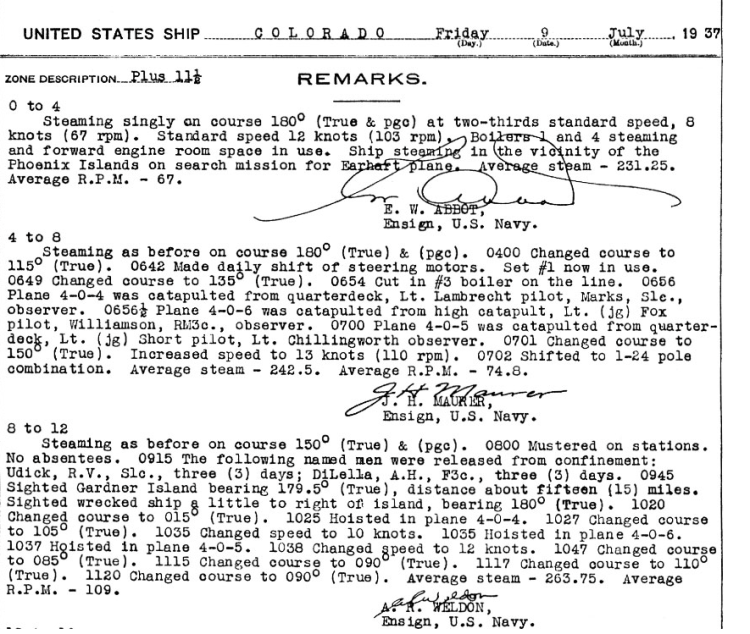
When it became apparent, on July 2, 1937, that the plane carrying Amelia Earhart and Fred Noonan was lost and would not be landing at Howland Island as planned, the Coast Guard cutter Itasca, which had been dispatched to Howland to assist Earhart, contacted US Navy headquarters in Honolulu and requested assistance with a search. The Navy sent the battleship USS Colorado from Pearl Harbor.
While the Colorado was en route, Itasca headed northwest from Howland in the direction of a large cloud bank which had obscured visibility. Because of problems with equipment, Itasca could receive radio transmissions from Earhart, but she could not receive from Itasca. The last transmission from Earhart reported that they were on line157 337, which is a northwest to southeast navigational line that bisects Howland Island. Southeast of Howland on this line is Nikumaroro Island.
Nikumaroro is twice the size of Howland, and has a large central lagoon that Howland lacks. The other distinguishing feature at Nikumaroro in the summer of 1937 was the wreck of a tramp steamer on the outer reef.
In the midst of a nocturnal tropical storm in late November, 1929, the freighter Norwich City ran aground. Initially, the captain hoped to keep the crew aboard ’til daylight. That plan had to be abandoned when a fire that had started in the engine room spread out of control. Fortunately, an SOS was sent. Two lifeboats were lowered, but both quickly overturned in the rough surf. In the chaos that followed, some men drowned, some were taken by sharks, and others managed to make it ashore. All who made it ashore had been cut on the coral reef. At sunrise, twenty-four survivors were counted, and they spent the next week waiting to be rescued. They constructed a large shelter using tree branches secured by salvaged canvas and rope. They hunted birds and crabs and searched for drinking water. When two freighters from Samoa reached them a week later, they left behind the considerable evidence of their recent habitation; they left the bodies of the dead sailors; and they left the Norwich City, which was still high on the reef, when eight years later, on July 9, 1937, three recon float planes from the USS Colorado flew overhead.
The planes were looking for a Lockheed Electra and its two occupants. They found nothing. The significance of this cannot be overemphasized. Between July 2 and July 13, there were widespread reports of radio transmissions from Earhart. In order to transmit, she required an aircraft. If the transmissions were authentic, they could not have been coming from Nikumaroro.
Recently there has been renewed speculation regarding Nikumaroro as Earhart’s final resting place. Such speculation ignores the conclusion of the U.S. Navy that the plane sank, (“eighteen thousand feet down”) and it ignores the search conducted by the float planes from the Colorado only seven days after Earhart’s Electra went missing. Finally, if Earhart’s aircraft did in fact manage to land at Nikumaroro, following navigational line 157, it first had to pass directly over Howland where the Itasca waited, smoke belching from her smokestack; all eyes on the empty morning sky.
 The Ruler of the Heavens