Spirits of Darkness primeval,
Spirits of Light,
To Kane, the eternal,
To Kanaloa, the eternal,
To Hoomeha, the eternal,
To all my ancestors from eternity,
To Ku-huluhulumanu, the eternal,
That you may banish the darkness,
that we may enter the light.
To me, give divine power,
Give intelligence,
Give great success.
Climb to the wooded mountains,
to the mountain ridges,
Gather all the birds,
Bring them to my gum
to be held fast.
Amen Ua Noa (the kapu is lifted, the way is open).
Emerson, Bird-hunters of Ancient Hawaii, 1895
 It all started with a name; an elusive, mysterious, auspicious, magical name, one sufficient

to provide all the incentive necessary to solve the mystery surrounding my Hawaiian great great

great great grandfather. For most of my life, it languished on a nineteenth century deed

supposedly connected to our mother’s native ancestors. But when I discovered that it was one of

the most powerful names in Hawaiian mythology, everything changed, and solving the mystery of

Kanehoalani became an obsession.
 Sadly, during my mother’s lifetime, we children neglected her family history, in no small part

because there was so little available. Just two names on a deed, and a cryptic reference to a

family homestead in Kama’e’e, a tiny ahupuaa of which no one had heard on the Hamakua coast,

between Ninole and Hakalau, on the island of Hawaii. Her Caucasian ancestors had come ashore

and closed the door on their former families and homelands.  Consequently,  our mother was not

always a source of reliable information. For example, her statement about her Grandfather

Wessel’s Germanic origins was incorrect. She said we could be part French, because the Wessels

were originally from Alsace-Lorraine. They weren’t; they were from Schleswig-Holstein, which

explained the ten percent Scandinavian (and no French) that turned up when I did a DNA test

recently. In the age of the internet and DNA tests, the truth will out. A computer search found

a biography for our Wessel great grandfather, who had sailed from Hamburg in 1852 on the

Deutschland to escape Kaiser Wilhelm, and settled near Davenport, Iowa, at Belle Plaine, where

he became a farmer, and later, a canning factory manager.
     For a long time I assumed there were no comparable source or sources of information

regarding our mother’s Hawaiian ancestors. I was wrong.

     One day while searching my Hawaiian dictionary, something or someone directed me to the

Glossary of Hawaiian Gods, where I found Kanehoalani described as the “ruler of the heavens”.

The Hawaiian Zeus. Out of the blue. I was transfixed. My great- great- great -great

grandfather, the ruler of the heavens? Why, how such an auspicious name? So I asked my native

ancestors, out loud, and over the next few months and years, bit by bit, the answer

materialized.

      It was shortly thereafter that I had my first encounter with the current ruler of the

Hawaiian heavens, in the form of a native hawk (b. solitarius). I had been hiking in the wild

eastern valleys for thirty years or more, and had seen the shorebirds, but on this day

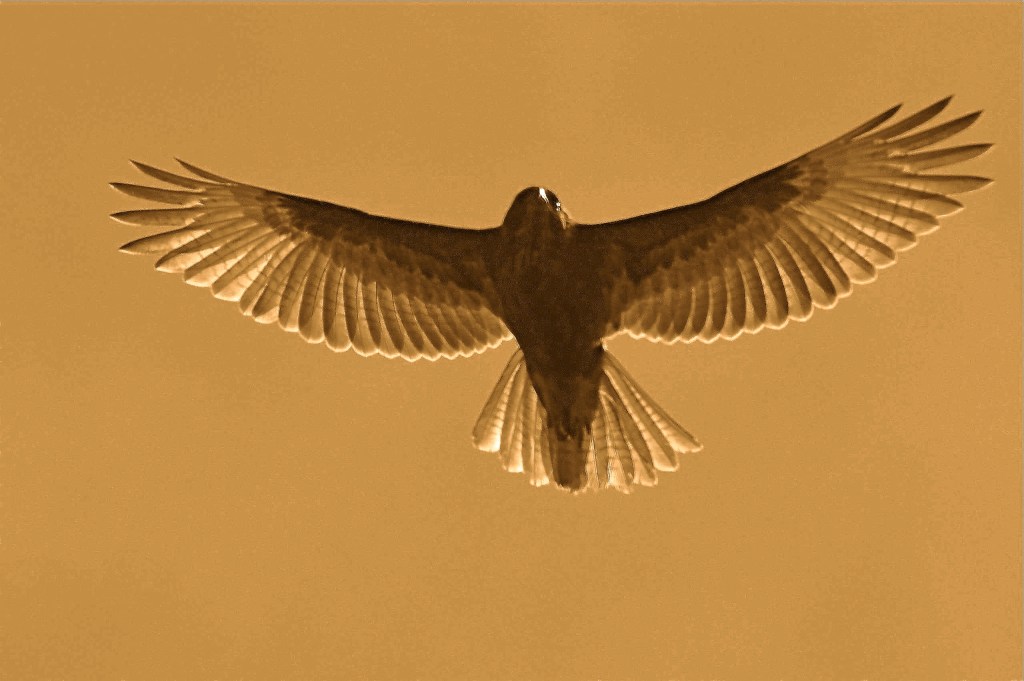
I heard a compelling, high-pitched call, and directly overhead was the hawk, great wings

extended, motionless on the wind.  I was utterly awestruck, enthralled. It was not just a bird.

It was by far far the largest winged creature I had ever seen in the Hawaiian sky, and its

sudden appearance lent an unavoidable element of mystery to it. I had gooseflesh on my head,

neck, shoulders and arms. A signal? Absolutely. Hawaiians have a word to describe just this

event. They call it ho’ailona, a strong signal or omen. I left the shorebirds and began to

follow the majestic hawk. It was as if by following this ancient, solitary native, I had found

a way to connect more deeply with my own forebears. The call of that unique, royal native was

resonating in my genes. Although in that moment I was not fully aware of it, the hawk would

lead me home.

     Thereafter, there were daily encounters.   I upgraded my camera equipment, in order to

have a record of the encounters, and soon there was a growing collection of images that evolved

into a book and a slide collection.

     Ornithology had not been part of my previous educational curriculum.  It was now. I began

to distinguish the larger, broad-winged natives from the occasional peregrine, with the

pointed, swept-back wings and black mustache. The native owls were easily identified by their

much larger heads, and their lower, slower flight paths. The silent, stealthy owls listened as

they flew, the hawks and peregrines were all very sharp-eyed motion detectors.

      Family members assisted.  My sister wrote an insightful story about Kanehoalani’s

granddaughter, our great great grandmother, Rebecca Ioela, and her ancestral home at Kama’e’e.

The steamer stop on the coast nearest Kama’e’e was called Pohakumanu (bird rock). From there it

was a steep climb up the flanks of Mauna Kea to the family compound. Our ahupuaa was located

next door to Hakalau, which translates as “many perches”, a place where birds congregated.

              There was one more piece to the family puzzle.  Before she died, our mother

collected copies of Six Months in the Sandwich Islands, by Isabella Bird, to give to each of

her four children.  “Your great great grandmother is in this book”, she said, “A young native

 whom the Austins selected to guide Miss Bird on the Hamakua coast”.

          “ I shall never again see anything as beautiful as this fringe of the impassable
timber belt.  I enjoyed it more than anything I had yet seen; it was intoxicating,
my eyes were “satisfied with seeing.”  It was a dream, a rapture, this maze of
form and color, this entangled luxuriance, this bewildering beauty, through which
we caught bright  glimpses of a heavenly sky above, while far away, below
glade and lawn, shimmered in surpassing loveliness the cool blue of the Pacific.
Here in cool, dreamy, sunny Onomea, there are no stabbing mosquitos as at
Honolulu to remind me of what I forget sometimes, that I am not in Eden.”
                              ( Isabella Bird,  The Hawaiian Archipelago, Picador, p. 113)

     Isabella Bird arrived  in the tiny town of Hilo on the windward coast of the island of

Hawaii in the winter of 1873.  An Edinburgh Scot traveling  for her health, she was soon

introduced to the Austins and their sugar plantation at Onomea, just north of Hilo on the

Hamakua coast. Stafford Austin had come from a line of New York lawyers and judges, while his

wife, Caroline Clark Austin, had been born in the islands, the daughter of an American

missionary.

     Bird and the Austins became good friends and the Onomea plantation became her base

of operations while she explored the island of Hawaii, and wrote the letters which later became

a book, the popular title of which is Six Months in the Sandwich Islands.

         Had serious thought been given to the idea of Rebecca Ioela and isabella Bird taking

horses along the Hamakua coast from Onomea to Waipio valley and back in January, the trip

would have been vetoed.  The Austins allowed the two to go because it was understood that

Rebecca’s uncle would accompany them.  Uncle’s horse had broken down.  He could not

go.  Rebecca’s unpredictable, unruly sixteen year old male cousin went instead.

          November marks the start of the rainy season on the windward coasts of the Hawaiian

Islands.  The northeast trades push the heavily laden clouds shoreward from far out to sea.

 Trapped against Mauna Kea, the clouds dump winter rain in ceaseless torrents.

     Between Hilo and Waipio Valley, sixty miles north, the rain has cut gorges, gulches

and a few larger valleys from the lower slopes of Mauna Kea.  Rivers run through each.

In summer the volume of water recedes, making for easy crossing.  In winter, the rivers

often flood, making crossing at times impossible.  In 1873, there were no bridges.

              Rebecca had two reasons for this trip, the first to act as guide, the second, to

stop at her grandfather’s compound at Kama’e’e, where her family had made a wedding

present for her.  That stop would be made on the way back from Waipio.

      Toward the end of the second day on horseback the rains came.  It would be many days

before it stopped.  Rivers would flood, putting lives at risk.

                         ********************************************

            …the roar was deafening, the sight terrific.  Where there were two
       shallow streams a week ago…there was now one spinning, rushing
       chafing foaming river, twice as wide as the Clyde at Glasgow…
       And most fearful to look upon, the ocean, in three huge breakers,
       had come quite in, and its mountains of white surge looked fearfully
       near the only possible crossing…Ibid. p. 148

      Between the deluge and the deep dark sea, on horseback, returning to Onomea,

the summer streams all now, by January, at flood stage, to cross or not to cross became

a decision with potentially fatal consequences.  Bird, older and more conservative, was

less willing to risk death.  Rebecca, much younger, on a stronger horse, and anxious

to get home to her husband, was inclined to take greater chances, and she plunged ahead,

yelling spur, spur, and aim horses’ head upstream.

      They stopped at Kama’e’e for the wedding present.   Miss Bird described riding an extra

mile mauka while on their way home, in order to visit her guide’s grandparents,  and to

receive a gift, a lei of bird feathers which Rebecca’s grandfather and granduncle had

made on the occasion of her recent marriage to Benjamin Macy of Nantucket.   Bird described

the lei as “a very beautiful as well as costly ornament, for which I am sure 300 birds must

have been sacrificed”.

          The birds had finally brought me home.  The intrepid Isabella Bird  was speaking of

our ancestors, Kanehoalani and Manuhoa,  and from her description it was clear that they were

bird collectors and feather workers.  What more auspicious names to give male children of

generations of Hawaiian bird collectors than Manuhoa and Kanehoalani?  Friend of birds

and ruler of the heavens indeed.

      My questions had been answered.  Our maternal native ancestry had been clarified in a

most unlikely way.  Our family owes a debt of gratitude to Miss Bird that can never be repaid.

Yet there she was, in the native cook house  of the family Kanehoalani, waiting for the chicken

to cook in the imu, with her guide, a bilingual member of the family.   They had  traveled a

mile from the main road back to a period hundreds of years  earlier, to an ancient time of bird

collectors, cape makers and kings.  If only she had thought to ask questions?  Were 300 birds

sacrificed in order to complete the feather wedding lei?   The birds, what of the birds?  Mamo?

Elepaio? Apapane? I’iwi?  The heavily tattooed native women who were present in the cook

house where it was warm and relatively dry, thanks to its thatched roof of pili grass; what of

those women?  What did the tattoos signify, if anything, beyond adornment?  She could have

learned so much more had she only thought to inquire.  But it was cold and wet on the windward

coast, and she had been on horseback for nine days,  narrowly escaping death while fording

flooded streams with our great great grandmother.   After all that, Bird must have been more

than ready to return to a hot bath and a dry, warm bed at the Austins.   But the worst

crossings were yet to come.  Miss Bird later attributed her survival to the Mexican saddle she

utilized.  Had she used an English saddle, she would have been swept away and drowned.

Fortunately for all of us, that did not happen.

          One can only hope that the feather lei survived the remainder of that wild trip.  By

1870, the bird which provided those feathers had been hunted to near extinction.  Further,

the two remaining men of my mother’s native family who had the expertise to capture the

last few birds and fashion the lei had grown older, and could no longer perform the arduous

collection work.  There was no one left in the family to carry on the ancient craft of cape and

feather lei making.   Barely in time, Bird had arrived to witness and document the end of the

age of bird collection and feather work at Kama’e’e.

          Today, in the deep forest above Hakalau, the brilliantly colored palila, ‘apapane and

‘elepaio that remain from the time of Manuhoa and Kanehoalani enjoy protected status.   One

hopes for their continued survival and proliferation.  As one of the curators from the British

Museum recently observed, the Hawaiians of old lacked the mineral resources necessary to create

jewelry fit for monarchs.  What they had instead were the endemic forest birds with their

dazzling feathers, and so my native forefathers collected them in order to acquire the

materials needed to craft the breathtakingly beautiful capes, leis and helmets worn by the

kings and queens of Hawaii.

     During her lifetime, my mother was, sadly, unaware of the calling of her cape making

native ancestors, the literary efforts of Isabella Bird notwithstanding.  I regret that my own

search for those forebears was not completed before her death.  Perhaps there could be a

degree of consolation in the fact that, seven generations later,  one of my grandsons carries

the Manuhoa name, and through the inspired work of Ms. Bird, Rebecca Ioela and my mother, the

auspicious history of that name, and that of Kanehoalani and Mahulualani will now be more

widely known within our family, if nowhere else, and my grandson,  if he is asked regarding

the origins of his name,  will be able to explain that he is the namesake of one who was a

member of an ancient Hawaiian family of bird collectors and feather workers who lived and

worked on the windward flanks of Mauna Kea on the island of Hawaii,  engaged in the unique

and exotic craft of creating feather cloaks and helmets for Hawaiian kings and queens.    And

his explanation, as improbable and astonishing as it sounds, will be entirely true.
                                                                                                                                                                                                                                                                                                                      Ua noa:  The kapu is lifted, the way is now open.

 The Ruler of the Heavens